woensdag 30 januari 2013

Raise an Emotionally Healthy Boy: Save Your Son from the Violent Boy Culture.


Introducing a new book by Ted Zeff, Ph.D.: Raise an Emotionally Healthy Boy: Save Your Son from the Violent Boy Culture. The book contains hundreds of practical methods to help parents raise their son to express his emotions and develop compassionate behavior, as well as specific strategies to help boys navigate through the violent boy culture. The book is available on amazon:  http://www.amzn.com/096607453X/?&tag=hspsurvivalco-20
at Barnes & Noble or by visiting www.drtedzeff.com.

Are you concerned that your son is constantly bombarded with false information that real boys must always be strong, aggressive, tough, and repress their feelings? What can parents do when their son is exposed to graphic, violent images of what a man is supposed to be like? How can parents help their son grow into an emotionally healthy, compassionate man when he is continually saturated with this distorted version of manhood from television, computer games, the Internet, movies, peers, coaches, and other adults?

In this groundbreaking book, psychologist Ted Zeff provides parents, educators, and mentors with many original and proven methods that will help boys grow into compassionate and emotionally healthy men who can transcend violent male behavior. Dr. Zeff offers practical advice that will help boys express their feelings, exhibit empathy, and increase their self-esteem in the family, at school, with friends, and in sports.

“Proven techniques to help parents raise their son to express his emotions and develop compassionate behavior, and specific strategies that will help boys to navigate through the violent boy culture.”
-Michael Gurian, author of The Wonder of Boys

Raise an Emotionally Healthy Boy” is a boon for our entire planet. The book provides many original, practical ideas for parents and teachers to help boys grow into compassionate and emotionally healthy men who can transcend male violent behavior. Give a copy to everyone you know who is helping to raise a boy.”
-Elaine Aron, Ph.D., author of The Highly Sensitive Child

“I met Ted Zeff when we both worked with youth in San Francisco 30 years ago. He was a great counselor then and now he is even a greater counselor and writer. His insights into raising young men are what is needed now. Trust me, I have been all over the United States making documentaries for PBS on reducing violence in schools. I implore you to listen to his excellent suggestions to raise compassionate, non-violent boys. He's right on.”
-Mike Pritchard, Host of PBS Documentary Save Our Schools from Hate and Violence and Stepping on Up


“Ted Zeff has provided everyone who cares about kids with an excellent road map to get us closer to a society where our boys become more fully human, more emotionally intelligent. That would mean a world of men better able to protect the planet and the next generation from the kind of emotionally disconnected aggression that threatens us all.”
-James Garbarino, PhD, Professor of Psychology, Loyola University Chicago, and author of Lost Boys


Thank you for your interest.

Ted Zeff, Ph.D.
www.drtedzeff.com   

maandag 19 november 2012

A Love Note to the “Hyper-Sensitive” and “Takers-of-it-Too-Personally”

Today I would love to share a beautiful blog posting by Randy Buckley from het blog page on : http://www.randibuckley.com

A Love Note to the “Hyper-Sensitive” and “Takers-of-it-Too-Personally”

by Randi
This post is inspired by a Facebook query and conversation with the deeply insightful and thoughtful, Erika Harris.  If this speaks to you, I encourage you to check out her website and gorgeous offerings. Thank you Erika for your grace and bright light.  

They say:  You’re too sensitive.  You take it too personally.  You’re thin-skinned.  You need to toughen up.

I hear: I have no idea how in touch with the world you are, nor can I grasp the depths of your empathy, from which I benefit. It’s like you can see colors that are naked to my eye.  You carry the awareness of others, of those far away, those unseen, in your heart on behalf of us all.  You are the torchbearer of the forgotten.  You bear the weight of other’s pain so they have a lifeline into the rest of humanity.  You are a barometer for how we are doing as a species.  I can’t imagine the space you hold for others to show up and feel cared for and acknowledged even when no one else can see that it’s you doing this.  You take on my share of pain when my words sting you.  You bear witness so that we know, so we cannot forget.  Your mere presence is equanimity.  Your energy is generously used in service of your ability to intuit and sense even the most subtle change in weather, perspective, mind or heart.  I’m not aware that your sensitivity can cause you physical pain.  You are a canary in the coal mine of our culture, and are wrecked by violent movies, news of pain, and mistreatment of fellow humans, animals, and the earth.  If I knew the depths of your consideration I’d be humbled and inspired.  I didn’t see or have the consideration that you are a gift and could be treasured.  Your light is omnipresent.  I don’t know to pay attention.  I don’t understand, even though I am the beneficiary of your grace. 

I say:  Thank you, friend.  Rest and take care.  We need you.

maandag 5 november 2012

Feeling like a victim

How highly sensitive people can become victims and what they can do to stop
Photo by nirrimi

In an earlier post, I wrote about the vulnerability of highly sensitive people to negative types of people, like narcissists. Because of their compassionate and empathetic nature, many HSPs unwittingly attract people who will use the HSP for their own gain and consequently drain the energy out of them in the process. When this kind of relationship becomes a pattern, it is all too easy for the HSP to take on the role of victim.

Assuming the victim role is not a natural or inevitable consequence of being highly sensitive, but it is a common one. Highly sensitive people are often misunderstood and misinterpreted as being socially anxious, depressed, insecure or possessing any number of other issues. When you are constantly being told that you are too shy, too reserved, too quiet and too sensitive, you begin to think there is something wrong with you. And when other people begin to take advantage of your sensitive nature, you can easily begin to feel like a victim.

But thinking of oneself as a victim is often a belief we’re not consciously aware of. Feelings of self-doubt, and believing that we somehow deserve the treatment we’re receiving, however unpleasant, often stems from childhood. A repeated belief in oneself as deserving of some kind of victimhood is usually the result of actual victimisation at an earlier stage, such as facing a bully at school or a controlling parent at home. After many years of mistreatment or even misunderstanding, the victim mentality becomes ingrained to the degree that people begin to believe it, even when they are not even aware of it.

Thinking of oneself as a victim is not only bad for your self-esteem, it’s also destructive to your relationships. People who are mired in victimhood expect to be treated badly, which means that they will become attracted to anyone who wants to use or abuse them and will actually feel uncomfortable around someone who treats them with unconditional love, simply because it feels so unfamiliar.

So how does a person who is highly sensitive to their environment and to the feelings of others protect themselves not only from the malevolent intentions of narcissists, but from the negative victim belief that increasingly develops in their own mind? Here are a few first steps:
• Recognise the words in your mind that repeat themselves, such as ‘I don’t deserve any better’ or ‘I’m such a loser’
• When you hear those familiar phrases in your mind, remember that they were probably spoken to you by someone who was suffering themselves, and didn’t know the real you
• Recognise that none of those negative things about you are true – you were told lies but now you now the truth – you are a kind, compassionate person who deserves unconditional love
• Stop accepting anyone who talks to you negatively or treats you badly.
• Create a new belief system for yourself, beginning with the belief that you are not a victim

It is the beliefs in our subconscious mind that often control our behaviours, actions, decisions and choices in life. If you suspect that you have been treated like a victim, take the first step by refusing to act like a victim any more. You don’t have to be angry, but you do need to stop beleiving the negative talk in your head. Once you do that and start thinking of yourself in a more positive way, your life will begin to change for the better and the narcissists will stop beating a path to your door. All they will find is a door that won’t open to anything but kindness.

maandag 1 oktober 2012

THE COEXISTENCE OF SENSITIVITY & OVEREATING


The correlation between being a Highly Sensitive Person (HSP) and an emotional eater is too significant not to share.  It’s a pairing that I see often – and one that I see in myself.  The aim of this post is to share my knowledge of the Highly Sensitive Person in an effort to provide a sense of sanity to your emotional eating habits.   If you are anything like me, the tremendous shame surrounding your overeating has caused you to retreat from the world in an effort “fix” yourself.  When you begin to understand that the reason you are overeating is perfectly justified and completely sane – your mission to “fix” yourself will gently fade away.

So what exactly is a Highly Sensitive Person?  Being highly sensitive means you pick up more sensory inputs from your environment — you feel things more intensely (both your own feelings and those of others) and reflect deeply before acting.  In addition to having heightened sensory input, HSP’s are often physically sensitive to specific foods, making digestive issues and auto immune disorders commonplace.  Because of this high level of processing and analyzing, the body and mind are more likely to be overwhelmed, overstimulated and over aroused.   This is precisely where food comes into play.    

Overwhelm is the catalyst for unconsciously using food as a coping mechanism to oversensitivity of outside people, places, situations, and especially emotions.  Food becomes an escape route from a world that seems too much handle.  The HSP becomes a sponge for the stress of the world – literally absorbing it into their bodies.
Highly Sensitive People have a strong propensity to live in their heads – their strength lies in analysis.  The downside of hibernating in your head is that anxiety undoubtedly finds you there and will hold on to you for dear life.  When you feel yourself overwhelmed with anxiety, seeking solace with food – recognize your need to retreat.  When we honor that we are sensitive beings – we honor the part of us that needs time to recharge, restore and rest.  It’s a balance of finding life’s confines and the confines of our sensitive bodies – and finding a way to flourish within their boundaries.

I know being highly sensitive may seem like a weakness given it is masked in your overeating habits – but when you are not coping, your sensitivity will paradoxically be your greatest gift.  Because HSP’s have the capacity to see what others may miss, they are natural visionaries, peacemakers, creatives and humanitarians.  So you see, you are not a problem to be “fixed”, rather a tenderness to appreciate.

To gain a deeper understanding of the Highly Sensitive Person, I highly recommend Elaine Aron’s, The Highly Sensitive Person.

Source: http://katestefans.com/?p=328

zondag 12 augustus 2012

Understanding the Highly Sensitivity Person: Sensitive, Introverted, or Both?

Today I would like to share a post by Elaine Aron as published in Psychology Today Published on July 21, 2011 by Elaine N. Aron, Ph.D. in Attending to the Undervalued Self


A fresh approach to those times when you doubt your own worth

woensdag 11 juli 2012

10 Myths About Introverts

Photo credit @ Anna Wojnarowska

Synopsis

Labeling someone as an Introvert is a very shallow assessment, full of common misconceptions.


This article originally appeared at Carl Kings' website Carlkingdom.com


Some time ago I was lucky enough to discover a book called, The Introvert Advantage (How To Thrive in an Extrovert World), by Marti Laney, Psy.D. It felt like someone had written an encyclopedia entry on a rare race of people to which I belong. Not only had it explained many of my eccentricities, it helped me to redefine my entire life in a new and productive context.

Sure, anyone who knows me would say, “Duh! Why did it take you so long to realize you’re an Introvert?” It’s not that simple. The problem is that labeling someone as an Introvert is a very shallow assessment, full of common misconceptions. It’s more complex than that.

A section of Laney’s book (page 71 through page 75) maps out the human brain and explains how neuro-transmitters follow different dominant paths in the nervous systems of Introverts and Extroverts. If the science behind the book is correct, it turns out that Introverts are people who are over-sensitive to Dopamine, so too much external stimulation overdoses and exhausts them. Conversely, Extroverts can’t get enough Dopamine, and they require Adrenaline for their brains to create it. Extroverts also have a shorter pathway and less blood-flow to the brain. The messages of an Extrovert’s nervous system mostly bypass the Broca’s area in the frontal lobe, which is where a large portion of contemplation takes place.

Unfortunately, according to the book, only about 25% of people are Introverts. There are even fewer that are as extreme as I am. This leads to a lot of misunderstandings, since society doesn’t have very much experience with my people. (I love being able to say that.)
So here are a few common misconceptions about Introverts (not taken directly from the book, but based on my own life experience):

Myth #1 – Introverts don’t like to talk.
This is not true. Introverts just don’t talk unless they have something to say. They hate small talk. Get an introvert talking about something they are interested in, and they won’t shut up for days.

Myth #2 – Introverts are shy.
Shyness has nothing to do with being an Introvert. Introverts are not necessarily afraid of people. What they need is a reason to interact. They don’t interact for the sake of interacting. If you want to talk to an Introvert, just start talking. Don’t worry about being polite.

Myth #3 – Introverts are rude.
Introverts often don’t see a reason for beating around the bush with social pleasantries. They want everyone to just be real and honest. Unfortunately, this is not acceptable in most settings, so Introverts can feel a lot of pressure to fit in, which they find exhausting.

Myth #4 – Introverts don’t like people.
On the contrary, Introverts intensely value the few friends they have. They can count their close friends on one hand. If you are lucky enough for an introvert to consider you a friend, you probably have a loyal ally for life. Once you have earned their respect as being a person of substance, you’re in.

Myth #5 – Introverts don’t like to go out in public.
Nonsense. Introverts just don’t like to go out in public FOR AS LONG. They also like to avoid the complications that are involved in public activities. They take in data and experiences very quickly, and as a result, don’t need to be there for long to “get it.” They’re ready to go home, recharge, and process it all. In fact, recharging is absolutely crucial for Introverts.

Myth #6 – Introverts always want to be alone.
Introverts are perfectly comfortable with their own thoughts. They think a lot. They daydream. They like to have problems to work on, puzzles to solve. But they can also get incredibly lonely if they don’t have anyone to share their discoveries with. They crave an authentic and sincere connection with ONE PERSON at a time.

Myth #7 – Introverts are weird.
Introverts are often individualists. They don’t follow the crowd. They’d prefer to be valued for their novel ways of living. They think for themselves and because of that, they often challenge the norm. They don’t make most decisions based on what is popular or trendy.

Myth #8 – Introverts are aloof nerds.
Introverts are people who primarily look inward, paying close attention to their thoughts and emotions. It’s not that they are incapable of paying attention to what is going on around them, it’s just that their inner world is much more stimulating and rewarding to them.

Myth #9 – Introverts don’t know how to relax and have fun.
Introverts typically relax at home or in nature, not in busy public places. Introverts are not thrill seekers and adrenaline junkies. If there is too much talking and noise going on, they shut down. Their brains are too sensitive to the neurotransmitter called Dopamine. Introverts and Extroverts have different dominant neuro-pathways. Just look it up.

Myth #10 – Introverts can fix themselves and become Extroverts.
A world without Introverts would be a world with few scientists, musicians, artists, poets, filmmakers, doctors, mathematicians, writers, and philosophers. That being said, there are still plenty of techniques an Extrovert can learn in order to interact with Introverts. (Yes, I reversed these two terms on purpose to show you how biased our society is.) Introverts cannot “fix themselves” and deserve respect for their natural temperament and contributions to the human race. In fact, one study (Silverman, 1986) showed that the percentage of Introverts increases with IQ.

“You cannot escape us, and to change us would lead to your demise.” <-- I made that up. I'm a screenwriter.

It can be terribly destructive for an Introvert to deny themselves in order to get along in an Extrovert-Dominant World. Like other minorities, Introverts can end up hating themselves and others because of the differences. If you think you are an Introvert, I recommend you research the topic and seek out other Introverts to compare notes. The burden is not entirely on Introverts to try and become "normal." Extroverts need to recognize and respect us, and we also need to respect ourselves.
 
About Carl King the author of : "So, You're a Creative Genius....Now What?"

Under the names Sir Millard Mulch and Dr. Zoltan Øbelisk, Carl King has recorded or performed with Devin Townsend, Marco Minnemann, and Virgil Donati. His 2005 album, How To Sell The Whole F#@!ing Universe To Everybody... Once And For All! was co-released through Trey Spruance of Mr. Bungle's Mimicry Records. It was named as one of the top musical moments of 2005 in The San Francisco Bay Guardian. He is a pioneer drum-programmer and is endorsed by Toontrack's Drumkit From Hell software. The highest and lowest points of his music career were having lunch with (and then failing an invite-only bass audition for) Steve Vai. Carl has written for mental_floss, INK19, and 2600: The Hacker Quarterly. He lives in Los Angeles and has never owned a car.

Source: http://www.creativitypost.com/pop-culture/10_myths_about_introverts

woensdag 15 februari 2012

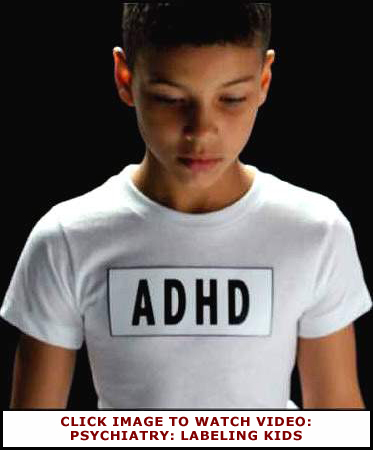
Labeling Kids with Bogus 'Mental Disorders'


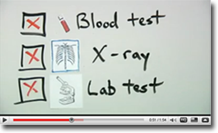
20 million children are labeled with "mental disorders" that are based solely on a checklist of behaviors. There are no brain scans, x-rays, genetic or blood tests that can prove they are mentally ill, yet these children are prescribed dangerous and life-threatening psychiatric drugs. Child drugging is a $4.8 billion-a-year industry.

1) THERE ARE NO TESTS IN EXISTENCE THAT CAN PROVE MENTAL “DISORDERS” ARE MEDICAL CONDITIONS.   PSYCHIATRIC DIAGNOSIS IS BASED SOLELY ON OPINION.
The psychiatric/pharmaceutical industry spends billions of dollars a year in order to convince the public, legislators and the press that psychiatric disorders such as Bi-Polar Disorder, Depression, Attention Deficit Disorder (ADD/ADHD), Post Traumatic Stress Disorder, etc., are medical diseases on par with verifiable medical conditions such as cancer, diabetes and heart disease.  This is simply a way to maintain their hold on a $84 billion dollar-a-year psychiatric drug industry that is based on marketing and not science.  Unlike real medical disease, there are no scientific tests to verify the medical existence of any psychiatric disorder.   Despite decades of trying to prove mental disorders are biological brain conditions, due to chemical imbalances or genetic factors, psychiatry has failed to prove  even one of their hundreds of so-called mental disorders is due to a faulty or “chemically imbalanced” brain.   To counter this obvious flaw in their push to medicalize behaviors, the psychiatric industry will claim that there are certain medical conditions that do not have a verifiable test so this is why there isn’t one for “mental illness.”  This is frankly a lame argument; Whereas there may be rare medical conditions that do not have a verifiable medical test, there are virtually no psychiatric disorders that can be verified medically as a physical abnormality/disease. Not one.
In fact the “brain scans” that have been pawned off as evidence that schizophrenia or depression are brain diseases, are simply bogus.  Most have not been done on drug naive patients, meaning someone who has not been on psychiatric drugs such as antipsychotic drugs, documented to cause brain atrophy (shrinkage).  Other brain scans have shown the brains of smaller children to show smaller brains in comparison to larger/older children and then claimed children with ADHD have smaller brains. None have been conclusively proven to verify mental disorders as abnormalities of the brain.
If there were such verifiable brain scans, or in fact any medical/scientific test that could show a physical/medical abnormality for any psychiatric disorder, the public would be getting such tests prior to being administered psychiatric drugs.
This is fact: There are no genetic tests, no brain scans, blood tests, chemical imbalance tests or X-rays that can scientifically/medically prove that any psychiatric disorder is a medical condition.  Period.  Whereas real diseases are discovered in labs, psychiatric disorders are invented by committee and voted into existence.


2. YES, PEOPLE CAN GET DEPRESSED, SAD, ANXIOUS AND EVEN ACT PSYCHOTIC.  THAT DOESN’T MAKE THEM  MENTALLY “DISEASED”

No one is saying that people don’t get depressed, sad, troubled, anxious, nervous or even sometimes act psychotic.  The question then is simple—is this  due to some mental “disease” that can be verified as one would verify cancer or a real medical condition?  And the answer is No.   For example, can soldiers returning from war experience extreme and often debilitating stress?  Yes.  It is something wrong with their brain?  No.  It’s the horrors of war. Can children become distracted and not pay attention?  Since time immemorial, the answer is yes.  But psychiatry has pathologized childhood behaviors into a “mental illness.”   The same is true of mothers.  Can a new mother become distraught after a joyous occasion such as the birth of a child?  Yes.  Is it a brain abnormality or mental disease?  No. And is the most humane solution to put these people on drugs documented by international regulatory agencies to cause mania, psychosis, worsening depression, heart attack, stroke, sudden death?  Or for new or nursing mothers to risk birth defects or damage to their infants from being prescribed such powerful drugs?
This is also true of people diagnosed “schizophrenic.” There is no medical test to verify someone has a brain abnormality or medical condition of schizophrenia. And while no one claims  people can’t become psychotic, the fact remains there is no biological evidence to support schizophrenia as a brain disease or chemical abnormality.  And consider this, if people do become psychotic, or irrational,  is it in fact caused by some  underlying medical (not psychiatric) problem?   And why did a 15-year multiple follow up study find that there was a 40% recovery rate for those diagnosed schizophrenic who did not take antipsychotics, versus a 5% rate for those who did?  What happened to their supposed “brain disease?” Did it simply vanish?  Moreover, if they could recover from such a mental state, do they deserve the “stigma” of “schizophrenia” still being part of their permanent medical record?  For life?   Think about it.  Imagine you were extremely overweight—obese.  You lose all the weight so you are no longer obese.  Yet your medical records continue to say that you are.
And if schizophrenia is in fact a “disease” despite the fact there is no medical or biological evidence (note we did not say speculation, or theories, but evidence) then why is it that psychiatrist Loren Mosher, the former Chief of Schizophrenia Research for the National Institute of Mental Health (NIMH) would openly state there is no biological condition of schizophrenia as a disease or brain malfunction? And why didn’t the mental health industry take advantage of his 2-year-outcome studies proving that those diagnosed schizophrenic could recover without the use of drugs? Is it because this proved that recovery was possible and thereby disproved the theory that something was wrong with their brain? Or was it the fact that they recovered without the use of drugs, thereby threatening a multi-billion dollar pharmaceutical industry?  Maybe this explains why Mosher was fired from his position at NIMH.


3. THE CAMPAIGN TO “STOP THE STIGMA OF MENTAL ILLNESS” IS BROUGHT TO YOU BY… BIG PHARMA
With a seemingly altruistic agenda, the fact is the campaign to end the “stigma” of mental illness is one driven and funded by those who benefit from more and more people being labeled mentally ill—pharma, psychiatry and pharmaceutical front groups such as  NAMI and CHADD to name but a few.   For example, take NAMI’s campaign to stop the “stigma” and “end discrimination” against the mentally ill—the “Founding Sponsors” were Abbott Labs, Bristol-Myers Squibb, Eli Lilly, Janssen, Pfizer, Novartis, SmithKline Beecham and Wyeth-Ayerst Labs. (For an in-depth look at what else Pharma funds and how this funding not only helps set mental health policies but campaigns such as this, read Pharmaceutical Industry Agenda Setting in Mental Health Policies at the bottom of this post)
The fact is that the  “stigmatization ” is coming from those that benefit from people being labeled/stigmatized with mental disorders that have no medical/biological evidence. Case in point, if you are rebellious, you are “stigmatized” with the label “oppositional defiant disorder.” If your kid acts like a kid he is “stigmatized” with the label “ADHD.” If you are sad, unhappy (even temporarily) you are “stigmatized” with the label “depressive” or “bi-polar disorder.” If you are shy you are “stigmatized” with the label “social anxiety disorder.” Moreover, you or your child are now stigmatized for life as this label, which is based solely on opinion, is now part of your medical record, despite the fact there is no medical evidence to prove you are “mentally ill”.


4. PSYCHIATRIC “LABELS” ARE THE PROBLEM
Increasing numbers of people  realize that just because a child fidgets, or loses pencils or toys—criteria for an “ADHD” diagnoses, this doesn’t mean a child is mentally ill.   In fact many now claim that children  diagnosed  “ADHD” are really suffering from lead toxicity, or allergies, or poor diet, or lack of reading skills, and not a mental “illness.”   The problem is that they continue to use the psychiatric label, ADHD, which stigmatizes a child as “mentally ill.”  If in fact a child suffers from led toxicity, then why not call it lead toxicity?  If he hasn’t been taught to read, why don’t we just say he hasn’t been taught to read?  The same is true of all psychiatric diagnoses—every single psychiatric label stigmatizes the person being labeled.    Psychiatric diagnoses are simply lists of behaviors that psychiatrists have compiled into little lists,  given a name,  added “disorder” on the end— then voted them into their billing bible, the Diagnostic and Statistical Manual of Mental Disorders (DSM)  as “legitimate.”   This is big, big business, but it isn’t even close to legitimate diagnoses.  Not in any medical or scientific context.   A profit making context? Sure.   Because coming up with new lists of behaviors and new “disorders” is the bedrock of the multi-billion dollar psychiatric/pharmaceutical industry.  Its how they get paid.   Remember, no psychiatric label, no billing insurance.  No psychiatric label, no drug prescribed.  So until we stop using these psychiatric labels,  which mean nothing other than what some psychiatrists decided was a mental “illness, ” we will never stop the “stigma.”  Because the psychiatric labels are backed by corporate interests—not medicine, and not science.


5. PSYCHIATRIC DRUGS ARE BIG BUSINESS—AND THE PSYCHIATRIC/PHARMACEUTICAL INDUSTRY IS MAKING A KILLING—$84 BILLION PER YEAR.

The primary reason people take psychiatric drugs is because they’ve been taught to believe they have a medical condition called a psychiatric disorder, which then justifies taking drugs to treat it.  This is a brilliant marketing campaign, but it is not science.  Any drug changes behavior or mood, whether cocaine, alcohol, marijuana or heroin. This does not mean someone who acts or feels differently on cocaine does so because they had a cocaine imbalance which the cocaine then corrected. It means that drugs changes mood, emotion and behavior.  But while the illicit use of drugs is universally frowned upon, and considered a bad way for people to deal with their problems, psychiatric drugs are made out to be “good” drugs, despite the fact many are more addictive than cocaine or heroin, and have side effects that rival such hardcore street drugs as LSD, heroin and crack cocaine.


6.  WHERE TO GET THE FACTS ABOUT PSYCHIATRIC DRUGS RISKS AND SIDE EFFECTS

Because the public has been so mislead by the psychiatric/pharmaceutical industry on the dangers of psychiatric drugs, CCHR has created a one-of-a-kind, easy to search psychiatric drugs side effects database, containing all international studies and drug regulatory warnings that have been issued on both classes of drugs (antidepressants, antipsychotics, anti-anxiety drugs, stimulants, etc) and brand names such as Prozac, Zoloft, Paxil, Risperdal, Seroquel, Ritalin etc.  These are provided by CCHR as a free public service to help people make educated decisions based on facts, not marketing campaigns


7. WHY SAFE, EFFECTIVE TREATMENTS TO MENTAL DIFFICULTIES ARE KEPT BURIED
The larger problem is that the biological drug model (based on the bogus mental disorders are a disease marketing campaign) prevents governments from funding real medical solutions for people experiencing difficulty.  And there are workable, non-harmful medical treatments that do not receive government funding because the psychiatric/pharmaceutical industry spends billions of dollars on advertising and lobbying efforts, including hundreds of their pharma funded “patient’s rights” groups to counter any medical modality that does not support their biological drug model of mental disorders as a disease. Why?  Billions of dollars in revenue for the psycho/pharma industry would be lost. This is an industry that time and again, has been proven to put profit above patients lives.
See various non-drug solutions/alternatives here:
http://www.cchrint.org/alternatives/

Bron: Citizens Commission on Human Rights International